
From Hohner’s Engineering Floors to Handmade Modern Classics
There are harmonicas that are bought. And then there are harmonicas that are kept, the kind that feel less like an object and more like a small, precise instrument that has found its true voice.
When players speak of Dannecker harmonicas, they rarely speak in casual terms. They speak as you’d speak of a trusted tool, a favourite knife, a well-made boat: with respect, and with that quiet certainty that craftsmanship has a sound. Indeed, Andy Irvine has used Dannecker harmonicas for many years, something I know first-hand, having repaired a number of them for Andy here at Harmonicas Ireland.
What follows is the clearest story I can piece together about Antony Dannecker, the generation before him, and the deeper roots behind the name, alongside a short note about the Dannecker instruments currently available here at Harmonicas Ireland.
A family line that runs back into Hohner’s history
One of the most cited origin points in Dannecker lore is 1895, when Antony Dannecker’s great-grandfather Carl Dannecker is described as being appointed an engineer at Hohner in Stuttgart, and dedicating his working life to the technical development and manufacture of harmonicas.
That detail matters, because it frames Dannecker not simply as a customiser who arrived late to the party, but as a name connected to the industrial heart of harmonica manufacturing from the inside out.
The same source states that four generations of the Dannecker family, including Antony’s father Willi Dannecker, worked within the harmonica industry (Hohner) and with professional harmonica players “right up to the present day.”
Willi Dannecker: the “brains behind the operation” and the professional repair lineage
In the harmonica world, there’s a particular kind of genius that doesn’t shout. It shows up in what works after years of use: airtightness that holds, reeds that speak evenly, slides that don’t fight you.
Multiple historical accounts describe Willi Dannecker as a key figure in this lineage and note the long-running connection between the Dannecker family and professional players, including the claim that Willi (and later Antony) served as harmonica repair man to virtuoso Larry Adler—a meaningful marker of trust at the highest level.
That repair pedigree matters because it explains the Dannecker “signature”: a maker who is not merely building, but solving the same problems elite players face, again and again, until solutions become instinct.
Antony Dannecker: craft, credentials, and the pursuit of “no compromise”
Antony Dannecker is frequently described as a UK-based harmonica craftsman with deep ties to Hohner-world knowledge, and he is open about positioning himself against mass manufacturing: emphasising material quality, precision, and the idea that if you start with inferior inputs, nothing else matters.
That same document notes Antony’s academic and professional credentials, describing him as a Doctor of Music and a Fellow of the Institute of Musical Instrument Technology and claims his work was informed by discussions with players and sound technicians in top recording environments, focusing on what they felt was lacking in their existing instruments.
For players, this often translates into the thing you can’t fake: a harp that feels settled, tight, responsive, and comfortable under the lips.
Notable Dannecker instruments and why they became coveted
The Genevieve (chromatic)
A particularly notable chapter is the “Genevieve” chromatic harmonica introduced in 2001—with only 100 instruments reportedly made, the first for Larry Adler, and built around a custom stainless steel body and covers.
The Dannecker Blues (diatonic)
On the diatonic side, players have long discussed the Dannecker Blues as a high-performance custom: often paired with premium Hohner components and shaped around comfort and response. A 2010 discussion among blues harmonica players describes Dannecker instruments as custom hand-built and focused on airtightness, responsiveness, and precise tuning.


The end of an era
The Dannecker website itself now states plainly that “Antony Dannecker Harmonicas is now closed.”
And when a maker like that closes, something subtle happens in the market: not hysteria, not hype, just scarcity with provenance. The instruments become a finite chapter.
The Dannecker harmonicas currently available at Harmonicas Ireland
I’m not interested in selling mystique. I’m interested in selling truthful instruments with clear provenance and honest descriptions.
At present, I hold three Dannecker instruments available for players and collectors, alongside one private presentation set held for reference and display.
1) Three Dannecker-tuned diatonics (excellent condition)
From the photo and physical inspection:
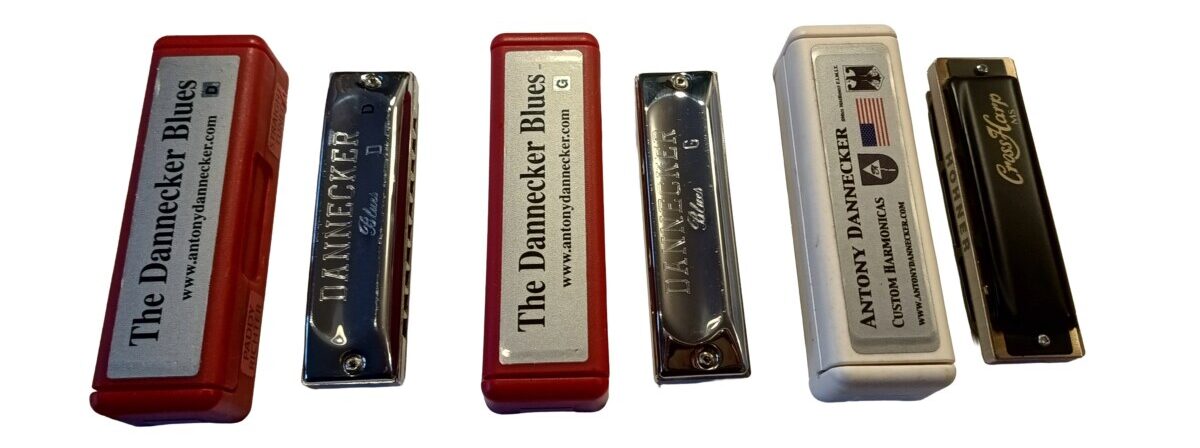
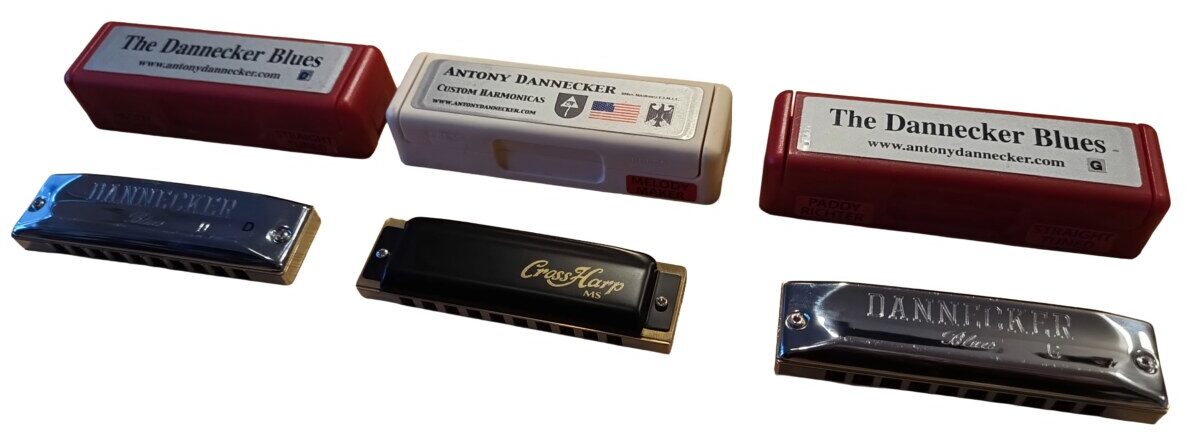
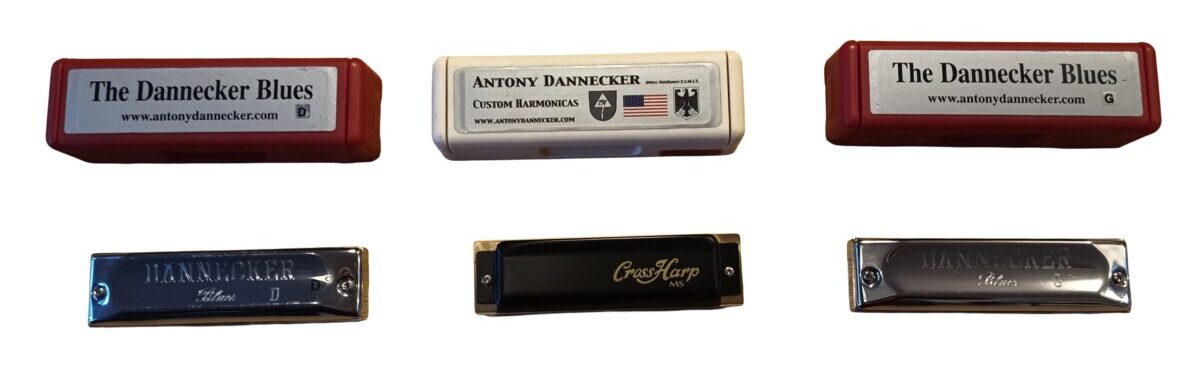
Dannecker Blues – Key of G – Paddy Richter (boxed; labelled; Dannecker tuning marks and file work visible)
Dannecker Blues – Key of D – Paddy Richter (boxed; labelled; Dannecker tuning marks and file work visible)
Dannecker-tuned Melody Maker on a Hohner Cross Harp base (lighter aluminium-style comb; Dannecker tuning markings on reed plates)
All three show the hallmarks collectors and players look for: workshop tuning marks, consistent tuning stability, and clear physical evidence of hand finishing.


2) A private presentation set: from workshop to stewardship
Among the Dannecker instruments held at Harmonicas Ireland is a markedly different kind of object: a complete presentation set created not for retail sale, but as a personal gift for a senior figure within the UK harmonica and Hohner ecosystem.
The set comprises two Optimus-style custom metal-comb harmonicas, each individually engraved, housed in the original Dannecker double-harmonica presentation briefcase and accompanied by the original satin drawstring bag and individual Dannecker-branded cases. The instruments remain in pristine condition and have not been played beyond minimal testing.
This was not a commercial pairing, nor part of any catalogue offering. It was made for a person rather than a market, a gesture of professional respect rather than a product line. As such, it occupies a space between instrument, artefact, and documented professional relationship.
With Anthony Dannecker’s workshop now closed and no further production possible, presentation pieces of this nature represent a finite and increasingly rare chapter in modern harmonica craft. Full provenance is held privately and can be shared where appropriate.


A small closing note, from one craftsperson to another
As a harmonica technician myself, I’ve handled many fine instruments.
But the ones that stay in memory are the ones that feel intentional, where every choice has a reason, every surface has been considered, every reed speaks without argument.
Dannecker harmonicas belong to that world.
If you’re interested in any of the Dannecker instruments above, get in touch through the shop or email, happy to provide detailed photos, close-ups of reed-plate markings, and a short playing demonstration where appropriate.
This article draws on archived manufacturer material and long-standing community documentation within the harmonica world.
Sources and Further Reading
Editor’s Note on Provenance and Discretion
This article has been written with care for both historical accuracy and professional discretion. Where individual makers, instruments, and documented lineages are discussed, names and details are included only insofar as they are already part of the public historical record or long-established community knowledge. In the case of private presentation instruments and non-commercial objects, full provenance is held but not publicly broadcast, out of respect for personal relationships and the original intent behind such works. This approach reflects a belief that some instruments are best understood not as commodities, but as artefacts shaped by craft, trust, and context, and that discretion is often part of their value.
