

Collectible Harmonicas: Why Are They Collectible?
Harmonicas, much like rare coins, vintage stamps or antique musical instruments, can hold significant value for collectors. Their worth often extends beyond just being instruments where they are pieces of history, have a story to tell or showcasing craftsmanship, rarity and unique features that make them highly desirable in the collector’s market.
Let’s dive deeper into why harmonicas are collectible.

Why Harmonicas Are Collectible
Limited Production
Certain harmonicas were produced in limited quantities, making them inherently rare. When production stops or a model is discontinued, the scarcity of these instruments increases their value. The Marine Band MS and especially the Rick Epping designed Hohner XB40 are excellent examples of a harmonica whose limited production has made it a highly sought-after collectible. When a harmonica is no longer available on the market, it automatically becomes more attractive to collectors who are interested in owning a rare piece of musical history.

Historical Significance
Vintage harmonicas, especially those from renowned manufacturers like Hohner and Seydel, often carry historical significance. Many harmonicas produced in the early 20th century reflect the craftsmanship and design trends of that era, making them prized historical artefacts. For example, the Marine Band MS, which was part of the Hohner Modular Series from the late 1980s, holds a special place in harmonica history. It was the last major model before Hohner transitioned to computerised production techniques and its short lifespan (produced only until the late 1990s) has made it a rarity among collectors.
The Richter System, developed by (Johannes?) Richter in 1825, remains the foundational tuning system for most diatonic harmonicas today. Harmonicas that feature this early design hold a particular place in history. An example of this is the rare 19th-century harmonica set attributed to Johannes Richter, which has been dated to around 1860. The set features ivory mouthpiece and movable flaps that interact to produce additional sounds. These harmonicas are a perfect example of the historical importance and craftsmanship that make certain harmonicas highly collectible.

Uniqueness
Some harmonicas feature unique designs, engravings or materials that make them stand out among others. Custom-tuned harmonicas, special editions and instruments that feature intricate etchings or unique materials add another layer of collectability. Even if these harmonicas weren’t initially marketed as collector’s items, their distinct features can make them desirable to collectors. These special harmonicas are prized not just for their musical potential, but for their rarity and distinctiveness.

Condition and Aesthetics
While playability is important for most musical instruments, collectibles don’t always need to be functional. Even harmonicas that no longer play well can be valued highly for their aesthetic appeal, such as unique engravings, vintage packaging, or unusual designs. Some collectors are more interested in owning a piece of history that looks beautiful, rather than simply an instrument that plays perfectly. For example, an early 20th-century harmonica with a beautifully engraved cover or a rare, unusual design can be far more valuable than one in perfect playing condition.

Desirability Despite Playability
Similar to rare coins that may never be spent or stamps that will never be used, collectible harmonicas don’t need to be in playable condition to have value. In fact, collectors often prioritise rarity and historical importance over playability. This is why harmonicas that are no longer functional can still fetch high prices. It’s about owning a piece of history, a unique artefact, rather than just an instrument to play music on.
Featured Examples
The Marine Band MS
A notable example of a collectible harmonica is the Marine Band MS, which was part of Hohner’s Modular Series. Released in the late 1980s, the initial concept was to replace handmade models with those produced on computer-controlled assembly lines. However, due to player backlash, Hohner limited the release of the Marine Band MS to Europe and production was discontinued by the late 1990s.
The Marine Band MS is easy to identify due to its larger size and thicker profile. It features reed plates that are held in place with screws, rather than the traditional nails seen on handmade versions. These early models faced some performance issues, but improvements in reed design and alloy quality were made in later production runs, making the Marine Band MS a valuable collector’s item today.

The Golden Melody (Old Version)
The original version of the Golden Melody harmonica is another prized collectible. Released in the 1970s, the Golden Melody was one of the first harmonicas to feature a sleek, curved cover design, setting it apart from the more traditional models of its time. Its smooth equal tuned sound and elegant design quickly made it popular among both professional and amateur players for melody playing as apposed to the old style Marine Band with its Just Intonation that produced rich fat chord. However, fairly recently the model was updated and changed, making the original version sought-after by collectors who appreciate its distinctive retro look and the warm, smooth tone that is characteristic of early Golden Melody models.

The XB40
The XB40, introduced by Hohner in the late 1990s, is another model that has become highly collectible, particularly due to its groundbreaking design, which caused a stir among harmonica aficionados around the globe. The innovative features were so impressive that I (the author) remarked, ‘Wow! I wished I had come up with that idea myself!’ While similar ideas have been suggested by others in the harmonica community, their designs lacked the unique, innovative comb of the XB40 and use of particular long style reed types crafted by Rick Epping and manufactured by Hohner. Designed by Rick Epping, the XB40 was crafted with a focus on incorporating auxiliary enabling reeds that amazingly allowed every reed from holes one to ten on a diatonic harmonica to bend down two tones! Additionally, hole three draw could bend in the same manner as a traditional blues harp, enabling the harmonica to be played chromatically but with greater expression, increased volume and responsiveness. Its robust construction made it a favourite among players seeking a powerfully louder, durable and expressive instrument. This combination of smooth expressive playability with these marvellous modern innovative features, along with screw-mounted reed plates has made the XB40 an enduringly popular model. With production now discontinued, it has become a highly desirable item for collectors, especially those interested in Hohner’s innovative designs.

Rory Gallagher’s Harmonicas at Auction
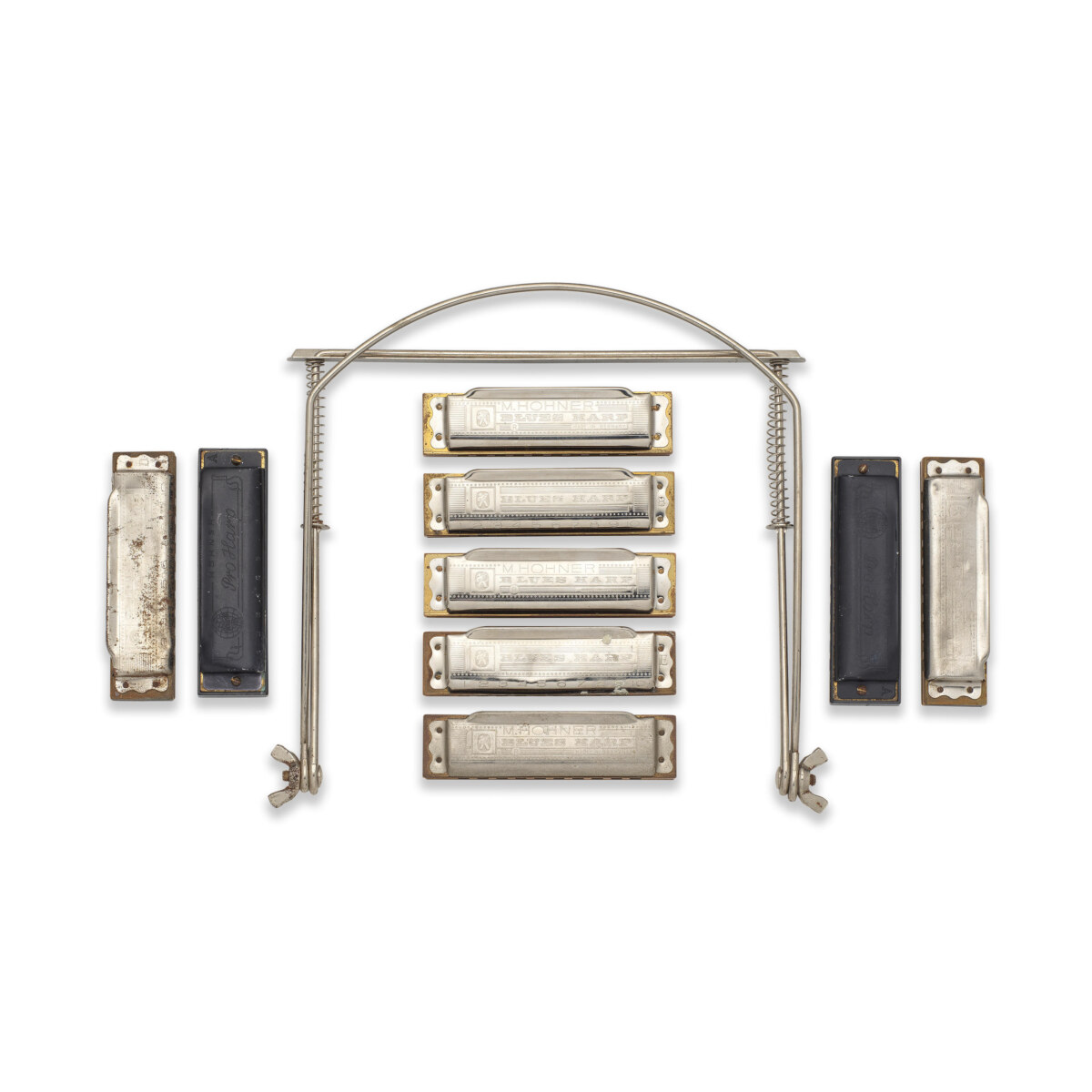
The legacy of Rory Gallagher, one of Ireland’s most iconic musicians, also contributed to the collector’s market for harmonicas. In October 2024, Bonhams auctioned a selection of items from Gallagher’s estate, including a collection of 19 harmonicas. These instruments, primarily Hohner models such as the Blues Harp and Pro Harp, were sold as part of a larger collection of memorabilia. Two harmonica lots, with one lot estimated to fetch between £1,200 and £1,800, ultimately sold for £1,024, with the final price, including the buyer’s premium, reaching £1,280.
This auction, which included other iconic items such as Gallagher’s 1961 Fender Stratocaster (which fetched £889,400), shows how much value is placed on instruments with historical significance. The harmonicas from Gallagher’s collection are not only prized for their connection to the legendary musician but also for their rarity and musical legacy.
For more details on this auction, check out the full sale on Bonhams: The Rory Gallagher Collection.
Rare Finds: Museum-Quality Harmonicas
To illustrate just how rare and valuable harmonicas can be, consider the harmonica set attributed to Johannes Richter, developed in the early 19th century. This set of three harmonicas, which features ivory mouthpieces and different tunings, is a perfect example of a museum-quality find. The craftsmanship and historical significance of these early harmonicas, dating back to around 1860, make them highly valuable to collectors. In fact, the set is considered a rare treasure, and its estimated value is around 2,000 euros.
For more on this rare set, check out the full feature on the Kunst + Krempel show on BR Fernsehen: Kunst + Krempel: Harmonica Set.

Conclusion
Collectible harmonicas are much more than just instruments—they are pieces of musical history. The rarity, historical significance, unique designs and aesthetic value of these instruments make them highly desirable to collectors. Whether they are rare due to limited production, their connection to important historical moments or simply their unique design features, collectible harmonicas represent a fusion of craftsmanship, music and history. Owning a collectible harmonica is not just about making music; it’s about owning a piece of the past
Interested in learning more about harmonica designs, custom tunings, custom-made harmonicas, harmonica, concertina and accordion repair services, harmonica restoration or exploring a wide range of harmonicas and lessons on playing harmonica, guitar, and accordion?
Visit Harmonicas Ireland,
Where Cathal Johnson, a master craftsman as a harmonica technician with over ten years of experience and a qualified Hohner technician and his colleagues, offer expert advice and services tailored to your needs. Discover our services, get personalised advice, and browse our collection.

