

The Lost Legacy of Hohner’s Irish Harmonicas: The Loughrea Factory
For decades, harmonica players across the world have recognised Hohner as a leading name in harmonicas. But what many may not know is that for a period of time, a factory in Loughrea, County Galway, played a crucial role in the company’s global production. This blog uncovers the story of Hohner Panarmonic Ltd., Loughrea, a factory that once produced thousands of harmonicas and provided employment for many in the west of Ireland.
(This article is part of a series on Hohner’s history and its impact on the harmonica world. Stay tuned for more in-depth explorations!)
The Establishment of Hohner Panarmonic Ltd. in Loughrea
In the early 1960s, Hohner, the German harmonica manufacturing giant, expanded its operations into Ireland. The Hohner Panarmonic Ltd. factory was established in Loughrea as a subsidiary of Matth. Hohner AG of Trossingen, Germany. The factory was intended to support global demand for harmonicas while taking advantage of Ireland’s skilled labor force and economic incentives.
The local government and business leaders saw this as an exciting industrial development for the region. Initially, 30 workers were employed, with plans for expansion up to 120 workers at full production.

Production and Irish-Made Hohner Harmonicas
The Loughrea factory specialized in tremolo and diatonic harmonicas, primarily for export markets. Some of the well-known models produced in Loughrea include:
- The American Ace – Clearly labeled “Made in Republic of Ireland,” this harmonica was aimed at the North American market and featured an airplane motif on the packaging.
- Lancer Harmonica – A diatonic model with decorative engravings and a distinctive knight emblem on its case.
- Fidelio 24-Reed Harmonica – A tremolo harmonica similar in style to Hohner’s Echo line.
- Apollo and Bugle Band (Koch-Harmonica) – These were sold under the Koch brand, which Hohner had acquired, further diversifying the factory’s production.
(Loughrea-made Lancer harmonica)

The Loughrea factory maintained high-quality craftsmanship, adhering to the same standards as Hohner’s main plant in Trossingen. Some of the materials, including reeds and plates, were shipped from Germany and assembled in Ireland.
Training and Cultural Exchange with Germany
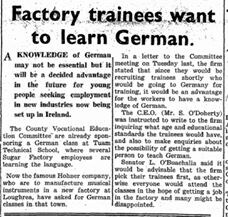
To ensure production standards matched those in Germany, Irish workers were sent to Trossingen for training. Historical photographs from 1962 depict groups of Irish workers, mostly women, who spent months in Germany learning harmonica assembly and tuning techniques before returning to work in Loughrea.
(A group of Irish workers training in Trossingen, Germany, 1962)

The exchange led to strong personal connections between Irish and German workers. Photos from the era capture moments of camaraderie, showcasing friendships that formed during this unique cultural and professional collaboration.
Economic Impact and Government Support
The Irish government was heavily invested in the success of the factory, providing infrastructural support:
- Water and Sewerage Extensions – A £2,000 investment was approved by the County Council to improve utilities for the factory.
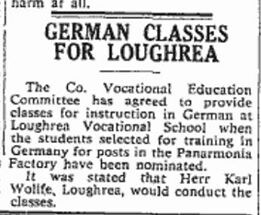
- Vocational Education Support – Recognising the need for specialised skills, German language classes were introduced at Loughrea Vocational School to prepare workers for training in Germany.
- State Subsidies – The factory was considered an important industrial employer, helping to diversify Loughrea’s economy beyond traditional sectors.
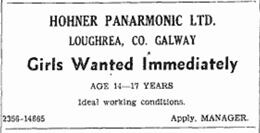
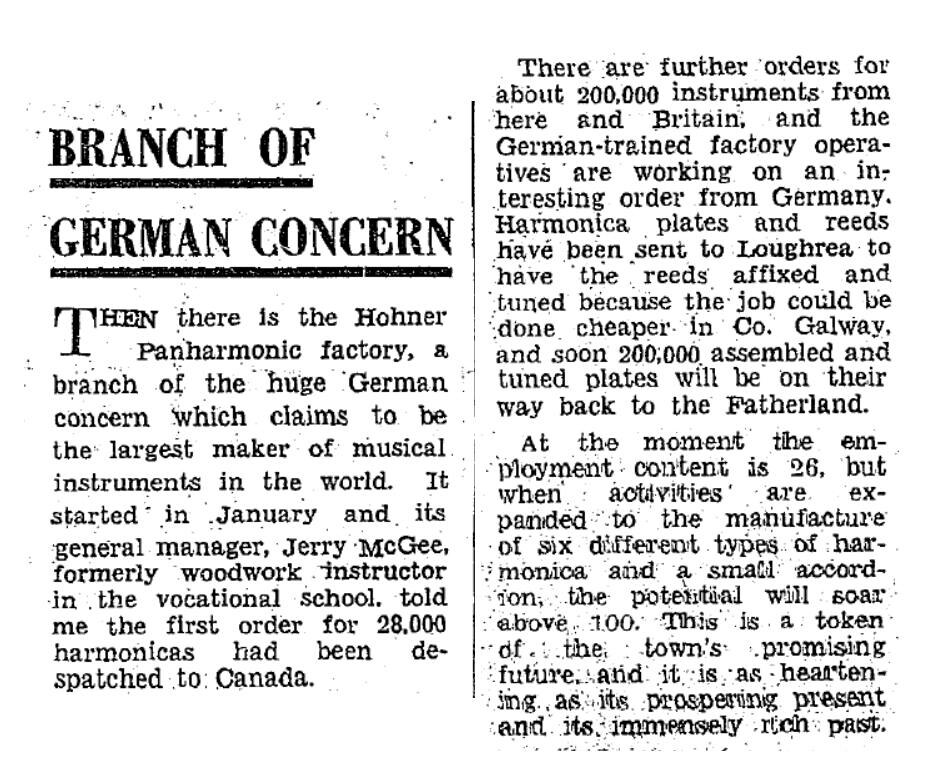
At its peak, the factory employed over 100 workers, playing a vital role in the local economy.
The Decline and Closure of the Factory
Despite its initial success, the Loughrea factory faced challenges:
- Declining global demand for harmonicas – By the late 1970s, harmonica sales were slowing as musical tastes changed.
- Hohner’s financial struggles – The company faced difficulties and had to consolidate production in Germany, leading to the decision to close satellite factories like Loughrea.
- Job Losses and Local Impact – The closure of the factory in the early 1980s was a significant blow to the town, ending a decade-long chapter in Irish manufacturing history.
By 1984-85, the last remaining equipment in the factory was dismantled and either sent back to Germany or sold off. The premises were eventually listed for sale.

Newspaper article announcing the closure of the Loughrea factory
Legacy and Rediscovery of Loughrea-Made Harmonicas
Today, Irish-made Hohner harmonicas are rare collectors’ items. Instruments like The American Ace, Lancer, and Fidelio serve as tangible reminders of this forgotten era in Hohner’s history.

Historical photographs of Irish workers in Trossingen further highlight the deep connection between Ireland and Germany in harmonica production.

Conclusion: An Important Chapter in Irish and Hohner’s History
The Hohner factory in Loughrea may be a little-known part of harmonica history, but its impact was significant. It provided employment, developed skilled workers, and contributed to Hohner’s global success. Though it closed in the early 1980s, its legacy lives on through the harmonicas that were made there and the memories of those who worked in the factory.
For harmonica enthusiasts and historians, the rediscovery of Loughrea-made harmonicas serves as a fascinating reminder of a time when Ireland played a role in crafting some of the world’s most famous musical instruments.
Do You Own a Loughrea-Made Hohner?
If you have a harmonica labeled “Made in Republic of Ireland”, you own a piece of musical history. Share your story in the comments or send us photos—we’d love to see these rare instruments!
Stay Connected and Join Our Community!
Want to stay updated on harmonica history, new discoveries, and special offers? Sign up for an account on our website today! Becoming a member gives you access to exclusive content, early product releases, and more.
Be sure to check out the rest of our Hohner history series, where we explore more forgotten chapters of harmonica manufacturing and innovations that shaped the instrument we love today. Scroll down to the bottom of this page to subscribe!
This article was researched and written by Cathal Johnson, founder of Harmonicas Ireland, with contributions from Martin Häffner, historical sources, newspaper archives, and insights from the factory workers themselves in an interview conducted by Cathal. Special thanks to those who have helped preserve the history of Hohner’s Loughrea factory.
